Loading page
Economics
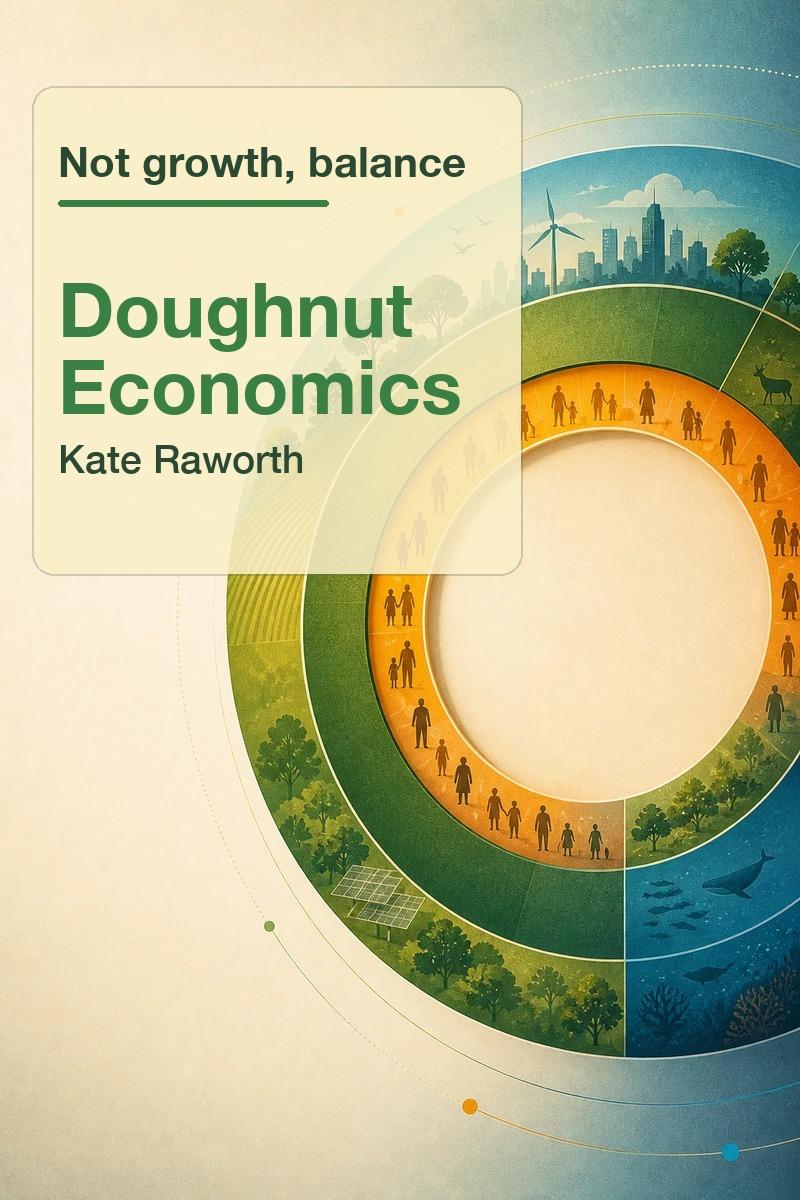
Doughnut Economics
Kate Raworth
Doughnut Economics
18 min
3 ideas from this book
What happens when you fine people for being late?
In a 1990s experiment in Haifa, Israel, daycare centers introduced a small fine for parents who were more than ten minutes late at pickup. The hope was that late arrivals would drop. Instead, the number of late parents doubled. The fine had turned guilt into a price.
Try today: Thank someone for a favour today instead of offering to pay for it.
What could happen to the leftovers of your morning coffee?
Less than one percent of a coffee bean ends up in your cup. The leftover grounds can grow mushrooms, then become animal feed, then manure.
Try today: Put your coffee grounds on a plant or in compost instead of the bin.
World leaders agreed on one number: 2.1 percent growth.
In 2014, the leaders of the world's 20 most powerful economies met in Brisbane, Australia. They talked about trade, infrastructure and jobs, and they stroked koalas for the cameras. Then they went home with one shared pledge: to grow their economies by 2.1 percent.
Try today: Next time growth is on the news, ask who it is for.
This book also has a Turkish summary
Open the Turkish book-summary page for Simit Ekonomisi and explore the same core ideas in another language.
A passage from the summary
A summary of Kate Raworth's Doughnut Economics. It sees the growth figure as a cuckoo in the economic nest and swaps it for a new goal: staying in the dough between a social foundation and an ecological ceiling. Along the way it embeds the economy in society and the living world, questions rational economic man and the Kuznets curves, and makes the case for distributive, regenerative design and being agnostic about growth.
Doughnut Economics book summary
Tellora's summary of Doughnut Economics is editorially prepared to help you explore the core ideas, notable insights, and practical takeaways from Kate Raworth in about 18 minutes. Read this Economics summary here, then listen to the full audio edition in the app.